
Fringe Repair & Replacement
Fringe is the end of the rug’s foundation, not decoration, so when it shreds the rug is unravelling from the ends inward. We secure the ends, rebuild lost warps, and replace or re-knot fringe to match the original.
Torn edges, missing fringe, moth grazing, a corner the puppy decided was a chew toy, or a rug that spent a night in three inches of water. Most of it is fixable by hand.
Rug repair is not patching. A proper repair rebuilds the rug the way it was originally made — foundation first, then pile, matched to the original knot density and dye lot — so the repaired section moves, wears and ages at the same rate as everything around it. Done properly, you have to be shown where it was.
That is slow work. Reweaving is measured in square inches, not square feet, and a hand on a loom is the only tool that does it. The upside is that damage most people assume is terminal usually is not. Rugs arrive folded around a hole and leave flat and whole.
Every repair starts with a free assessment and a straight verdict. If the cost of the work is out of proportion to what the rug is worth, you will be told that instead of being quietly invoiced for it.
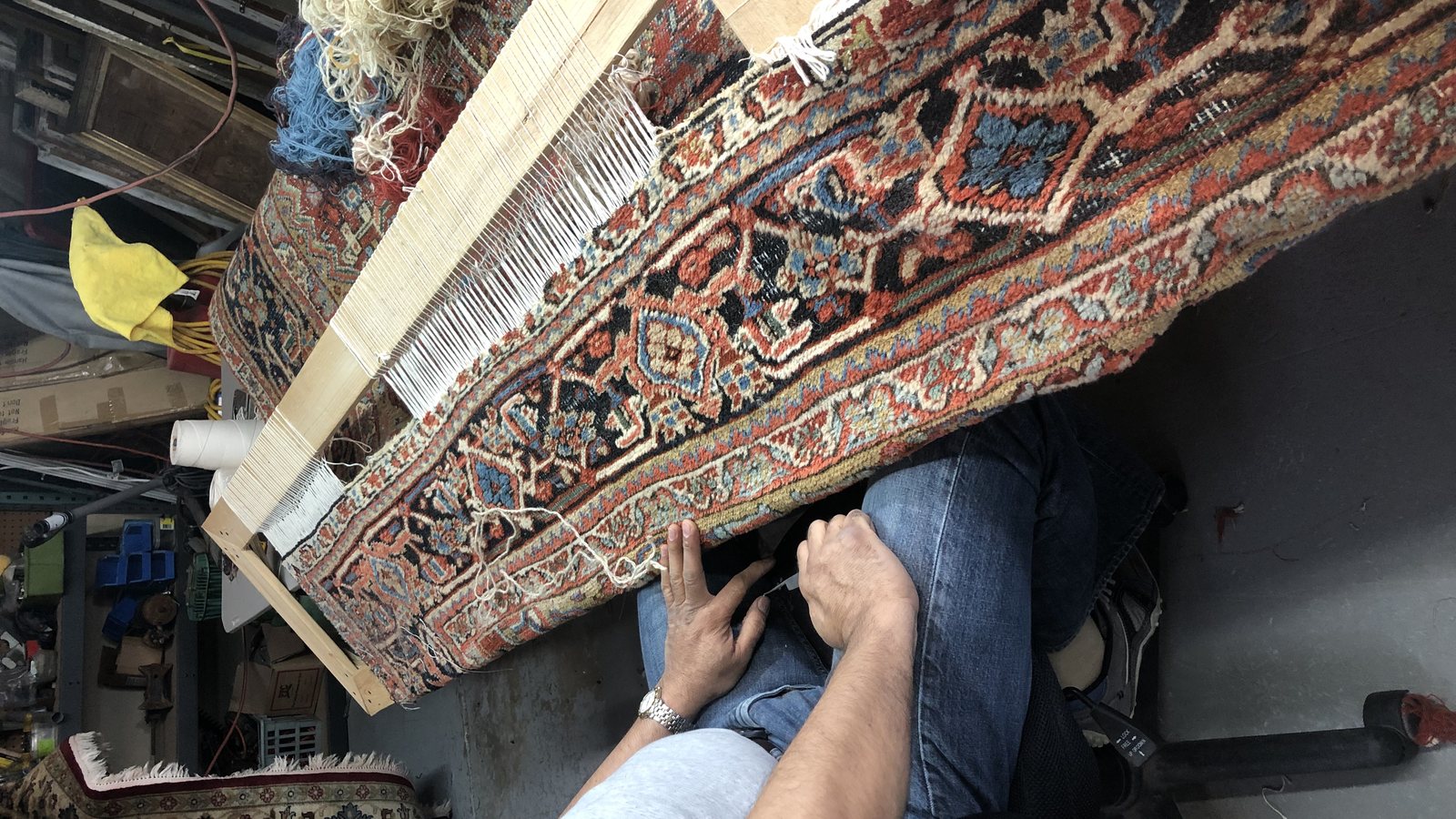
From a short fringe tidy to rebuilding a foot of missing border.
Fringe is the end of the rug’s foundation, not decoration, so when it shreds the rug is unravelling from the ends inward. We secure the ends, rebuild lost warps, and replace or re-knot fringe to match the original.
Side cords take the abuse from vacuum beaters and furniture legs. Once they split, the pile beside them starts letting go a row at a time. Edges are rewrapped by hand in matched wool.
Burns, tears and worn-through areas are rebuilt knot by knot. Foundation goes back first, then pile, matched in fibre, colour and density to the field around it and sheared to the surrounding height.
Moth larvae eat wool from underneath and avoid rugs that get walked on, so the damage starts under the sideboard and along the edge of the sofa. We treat the infestation first, then reweave the grazed areas. Formal rooms that stay still are where this happens.
Chewed corners, clawed edges and urine-burnt dye. Decontamination comes first, then the missing structure is rebuilt and colour corrected where the original dye was destroyed from underneath.
Sun-bleached bands from a big south-facing window, iron staining from clay or well water, bleach spots, and dye that migrated during a bad cleaning. Colour is rebuilt by hand where the fibre underneath is still sound.
Rugs cut down to fit a room, and rugs blocked back to square after years of buckling or a set fold from storage. Cut edges are properly finished so the rug reads as intentional rather than amputated.
Failed latex on hand-tufted rugs — common here, and worse in humid summers — brittle cotton warps in antiques, and rugs that ripple because the foundation has gone. Structure is fixed before anything cosmetic.
A large share of the repairs we do could have been prevented by a decent pad. Breathable, non-adhesive pads cut to the rug matter especially over a crawlspace, where a solid rubber pad traps damp against the foundation.
Greensboro sits at the dry end of this network: 127 days a year at or above 75% relative humidity, 34.9% of the calendar, which leaves 238 days when the air is not working against a rug at all. That changes the diagnosis before it changes the repair, because a moldy rug here is usually reporting a building fault rather than a season.
Greensboro is unusual in this network for being dry and cold at once: 127 damp days a year and 40.9 inches of rain, against 54 nights below freezing.
That combination moves the repair load away from rot and toward dimension. A heated house through a winter that long holds indoor air well below what the rug equilibrated to over the warm season, and cotton contracts as it dries.
A rug that has done that for a decade sits out of square, and the sides are usually shorter than the middle wants them to be.
Irving Park, Sunset Hills and Reynolda keep a lot of original wood floors, and an original board floor is a moisture path rather than a barrier.
Old boards shrink, gap and let air through from whatever is below them, so the rug over the top is in exchange with the underfloor space. That is fine for 238 days a year and not fine for the other 127.
The housing descriptions for Old Irving Park and Ardmore all mention crawlspaces, and a crawlspace is the reason a rug can be damaged from a direction nobody inspects.
Soil under an unvented crawlspace gives up moisture into the void, that moisture moves up through the floor, and the rug on top of it acts as the lid. The foundation loads from beneath while the pile stays dry to the touch.
The oldest housing on the collection route goes back to the 1880s, and construction of that age was not built to keep ground moisture out of the rooms above it — which is worth remembering before blaming a rug's condition on the rug.
Cellulose held damp loses strength, and 25 unbroken days above 75% is long enough for it to matter.
A foundation going that way gives no cosmetic warning, so the test is mechanical: fold a corner and see whether it flexes or crackles, and pull gently on a fringe tassel to see whether it is still anchored in anything.
A foundation that takes up moisture over 127 damp days and gives it back over 54 freezing nights of heated indoor air changes dimension twice a year, and wool and cotton do not change by the same amount.
The result is ripple, buckling and a rug that has quietly gone out of square; it is corrected by washing and blocking back under tension, not by moving the furniture.
Fringe is the warp ends of the rug, not a trim, so 127 days a year of damp working on cotton warps shows up there before it shows up anywhere else.
Once the ends let go the rug starts unravelling from the edge inward, which is why a fringe that has begun to shed is worth dealing with while it is still a fringe job.
Figures above are from the ERA5 reanalysis record for the five years from 2021 through 2025, taken at the center of the the Piedmont Triad service area. If what you are seeing on your rug matches any of this, send photographs and we will tell you which of these it is.
A supply line that let go behind a wall, a water heater that finally gave out, a washing machine hose, a pipe that froze in a January cold snap, or a basement that took water during a summer thunderstorm. Whatever the source, the rug on that floor is now on a clock.
Wool survives being wet surprisingly well. What it does not survive is staying wet. In Piedmont summer conditions mould establishes in a saturated foundation in roughly forty-eight hours, and once it is in the base of the pile you cannot vacuum, spray or air-dry it back out. Over the same period unstable dyes start migrating, cotton foundations begin to rot, and whatever was in the water — sewage from a backed-up line, silt from a basement, detergent, whatever ran across the floor — is curing into the fibre.
A fan pointed at a wet rug is not restoration. It dries the surface, locks the contamination into the foundation, and produces a rug that smells acceptable for a few weeks and then does not. The rug has to be flushed, not just dried.
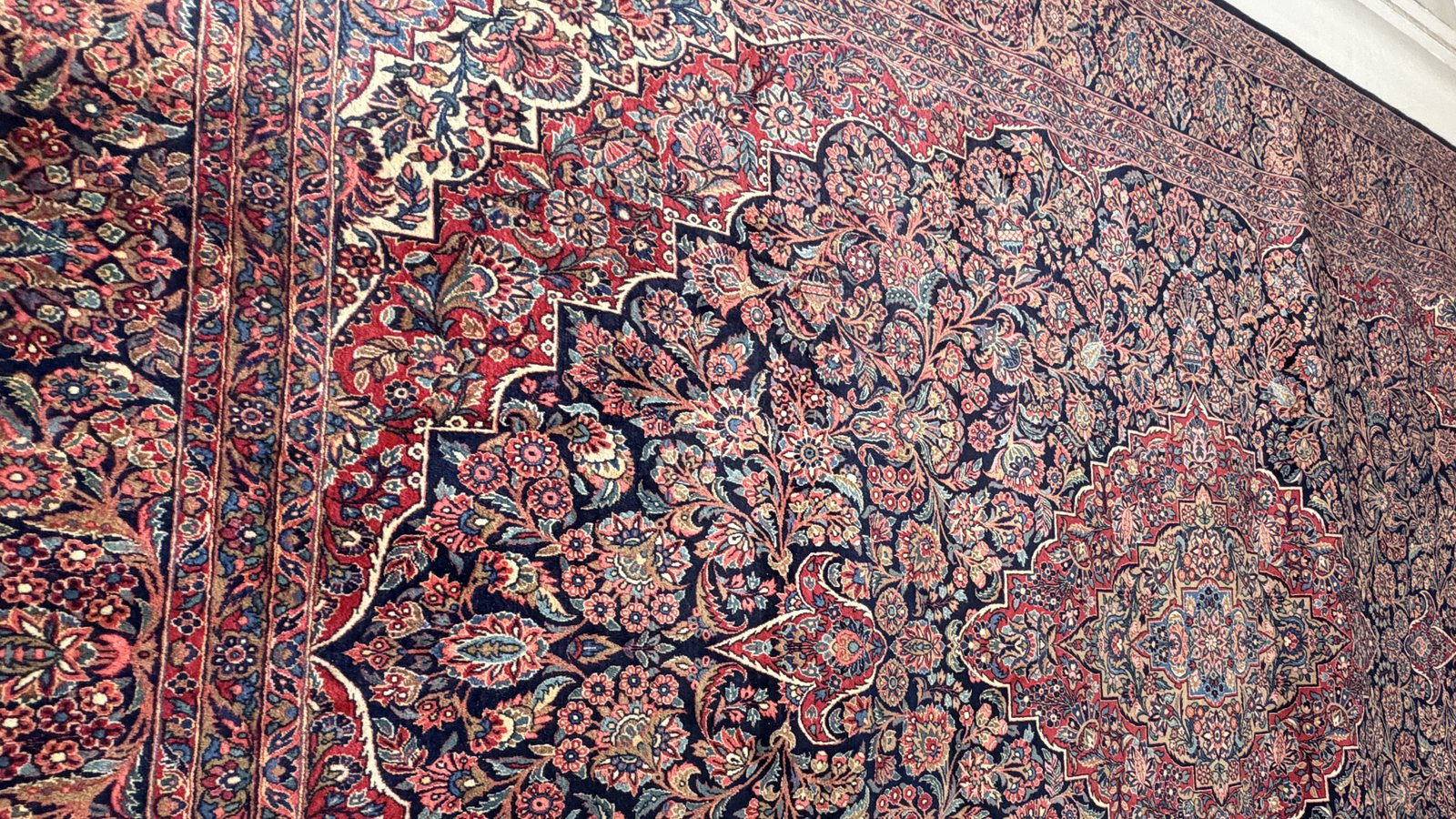
Send pictures of the damage, or the rug gets collected at no charge anywhere in Guilford or Forsyth.
The damage is mapped, materials identified, and you get a written price with options. Nothing starts without your approval.
Repairs go onto a clean rug. Working new wool into a dirty field guarantees a visible patch a year later, once the rest catches up.
Wool selected by fibre, weight and dye lot against the original, then tested against the field before any of it goes in.
Foundation rebuilt, then pile knotted in at matching density, then sheared level with the surrounding height.
Groomed, checked against the intake photographs, and delivered back to your floor.
Free assessment on every repair, including whether it is worth doing at all.
The six-stage hand wash every rug goes through, and why in-home wand cleaning fails here.
Cleaning processPollen, humidity, red clay and crawlspaces — what Triad rug owners are actually up against.
Care notesCollection and delivery included across Guilford and Forsyth counties.
Contact us